
Strengthening Consolidated Supervision of Financial Holding Companies
Following the Central Bank of Nigeria’s directive to discontinue the universal banking model, several Nigerian banks began restructuring into financial holding companies. While the new model aimed to ring-fence commercial banking activities and reduce systemic risk, it introduced complex supervisory challenges. Regulators needed to understand how diversified financial groups operate, how risks propagate across subsidiaries, and how to apply consolidated supervision to increasingly complex banking structures
82%
25%
average post-training competency scores across consolidated capital adequacy, ERM, and risk appetite framework design
reduction in time to assess consolidated capital adequacy
THE OPPORTUNITY
Building Capacity for Consolidated Supervision
As Nigerian banking groups transitioned to holding company structures, the Central Bank of Nigeria (CBN) recognised the need to strengthen its supervisory and regulatory capacity. Financial conglomerates introduce complex governance, capital, and risk management challenges, particularly when activities span banking, insurance, asset management, and other financial services.
Supervisors needed the technical skills to assess group-wide risks, evaluate consolidated financial performance, and manage cross-border exposures. The opportunity was to equip senior regulators with practical tools, methodologies, and international best practices for licensing, supervising, and regulating financial holding companies.
By building these capabilities, the CBN aimed to ensure the effective oversight of emerging holding structures, protect depositors through stronger ring-fencing of banking activities, and align Nigeria’s regulatory framework with global supervisory standards such as the Basel Committee’s principles on consolidated supervision.
THE SOLUTION
International Training and Supervisory Study Programme
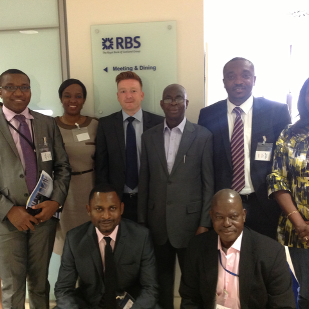
Mindset Resource Consulting (MRC) designed and delivered a two-week executive training programme for senior supervisors from the Central Bank of Nigeria’s Financial System Stability Directorate. The programme, delivered in Glasgow and New York, combined technical instruction with international study visits to leading regulatory and financial institutions, including the Federal Reserve Bank of New York and the Royal Bank of Scotland.
The curriculum provided a comprehensive examination of the regulatory, financial, and governance issues associated with financial holding companies. Participants explored the licensing and approval requirements for bank and financial holding companies, including governance structures, capital requirements, and permissible and non-permissible non-banking activities. The programme examined the regulatory rationale behind holding company models and how they can protect depositors by separating core banking activities from riskier financial services.
A major focus was on the application of consolidated supervision. Participants received detailed instruction on both qualitative and quantitative supervisory techniques. Qualitative modules examined corporate governance, enterprise risk management frameworks, board oversight, and the role of internal controls across complex financial groups. Quantitative modules focused on consolidated financial reporting, capital adequacy assessment, credit concentration risk, large exposures, and asset–liability management. Supervisors also explored international methodologies for calculating group-wide capital adequacy, including building-block and risk-based aggregation approaches.
Through case studies of global financial conglomerates, the programme addressed supervisory challenges such as double gearing, intra-group exposures, and regulatory arbitrage. Participants were trained in the use of analytical tools such as Bank Holding Company Performance Reports to evaluate financial condition and risk profiles. Discussions also covered cross-border supervisory coordination, enforcement mechanisms, and the regulatory oversight of international banking operations.
The combination of technical training and institutional engagement allowed participants to observe how consolidated supervision is implemented in mature regulatory environments. This exposure strengthened their ability to apply similar supervisory approaches within Nigeria’s evolving financial regulatory framework.


THE IMPACT
Stronger Supervision and Financial Stability
The programme significantly strengthened the Central Bank of Nigeria’s capability to regulate and supervise financial holding companies through a consolidated, risk-based supervisory framework. Participants enhanced their technical competence in assessing group-wide capital adequacy, evaluating governance and risk management structures, and identifying systemic vulnerabilities across financial conglomerates.
The training also informed the development of Nigeria’s regulatory framework for financial holding companies, supporting clearer licensing standards, stronger governance expectations, and more robust supervisory guidelines. Supervisors gained practical tools to detect risks such as double gearing, excessive leverage, and intra-group exposures, improving early-warning capabilities and the consistency of consolidated capital assessments.
Overall, the engagement reduced supervisory blind spots and strengthened the CBN’s ability to oversee complex banking groups. By aligning regulatory practices with international standards and enhancing supervisory expertise, the programme contributed to stronger financial stability and greater confidence in Nigeria’s banking system.